


MARKETS ARE GETTING HIT HARD TODAY
Not because one thing broke but because several major narratives are starting to weaken at the same time.
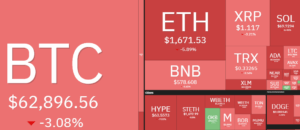
The biggest one remains the U.S.-Iran peace process. Just days ago, investors were pricing a best-case scenario. A roadmap had been agreed upon. Negotiations were continuing. Oil was falling. Risk assets were stabilizing.
Today, the market is realizing that agreeing to a framework and agreeing to the details are two very different things.
THE PEACE TALKS ARE PROGRESSING BUT THE DETAILS ARE A MESS
The first round of negotiations between the United States and Iran produced a 60-day roadmap toward a final agreement. Both sides described the talks as productive. Working groups were established, communication channels were opened, negotiations are continuing but a major disagreement has already emerged.
President Trump, Vice President Vance, and Treasury Secretary Bessent have all suggested that Iran has agreed to inspections of nuclear facilities as part of a broader process to ensure long-term compliance.

Iran says that’s simply not true.
Iranian officials have rejected the claims, describing them as “very damaging” and insisting that no new commitments were made regarding the nuclear file. Tehran has repeatedly argued that its policy of nuclear ambiguity remains one of its most important strategic assets and that inspections would only benefit its adversaries.
The result is a market trying to figure out whether both sides are actually talking about the same agreement. The roadmap exists but the destination remains unclear.
QUARTER-END SELLING IS ADDING TO THE PRESSURE
The weakness isn’t just about geopolitics. Markets are also heading into one of the largest portfolio rebalancing events of the quarter. According to JPMorgan, institutional investors may need to sell up to $165 billion worth of equities before June 30.
The breakdown includes:
- Japan’s GPIF: $60B
- Norway’s Sovereign Wealth Fund: $40B
- U.S. Pension Funds: $55B
Stocks have dramatically outperformed bonds during the quarter, forcing many large funds to reduce equity exposure and rotate capital back into fixed income. It’s not the only reason markets are weak but this remains one of the biggest technical factors weighing on prices right now.
THE SPACEX FOMO IS OVER
One of the market’s biggest momentum stories is also starting to collapse. SPCX dropped another 16.4% after launching a senior unsecured debt offering targeting at least $20 billion in new capital.
The decline erased more than $400 billion in market value in a single session. In just three trading days, SpaceX has now lost approximately $927 billion in market capitalization and sits more than 31% below its all-time high.
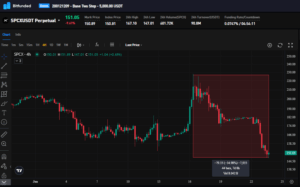
The selloff reflects a growing valuation debate. SpaceX remains one of the most ambitious companies in the world but even supporters are struggling to justify valuations that recently approached 175x forward EV/EBITDA and 62x revenue.
The market is beginning to ask whether the story got ahead of the fundamentals.
LONGS GOT ABSOLUTELY DESTROYED
The liquidation data tells the story.
Over the last 24 hours:
- Total liquidations: $713M
- Long liquidations: $596M
- Short liquidations: $117M
- Traders liquidated: 144,000+
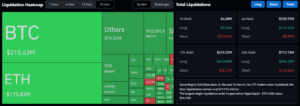
More than 80% of all liquidations came from longs. Bitcoin accounted for roughly $215M of the damage. Ethereum added another $176M. The market spent the last week trying to front-run a recovery. Today’s price action showed just how crowded that trade had become.
OIL IS BACK TO ITS LOWEST LEVEL IN 3.5 MONTHS
CL has completely erased the rally that followed the Middle East tensions. At the same time, short positioning in Brent crude has reached the highest level on record.
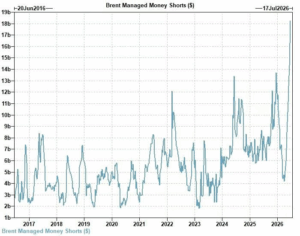
The market is aggressively betting that geopolitical risks continue easing and that energy supplies remain uninterrupted.
The most important support level now sits near $73. A break below that zone would confirm another leg lower.
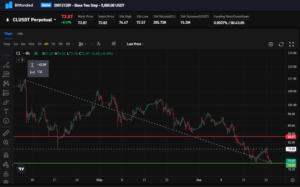
The key resistance area remains $79-$80. As long as crude stays below that level, sellers remain in control. The one thing worth noting: Positioning has become extremely crowded.
With record shorts sitting on the same side of the trade, any surprise escalation could trigger a violent short-covering rally.
WHAT’S CRYPTO TELLING US
BTC was rejected near the 25-day moving average. The most important support remains around $60K. If that level fails, downside pressure could accelerate quickly.
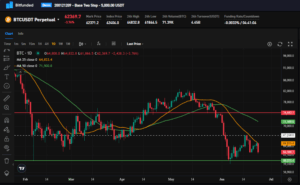
On the upside, bulls need to reclaim the $64.8K-$67.2K resistance zone before any meaningful recovery can begin. Until then, the trend remains weak.
Ethereum is beginning to look weaker than Bitcoin. It has lost both its 25-day and 50-day moving averages.
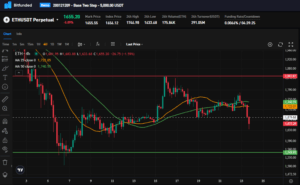
Those levels now sit near $1,720-$1,740 and act as resistance. The loss of $1,680 support is the biggest concern. The next major support level sits near $1,550. Unless ETH can quickly reclaim the moving averages, the path of least resistance remains lower.
More than 300 million ENA has been deposited onto exchanges during the last month. Large exchange inflows don’t automatically mean selling but they do increase the amount of supply available to hit the market.
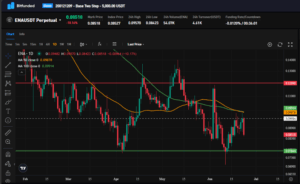
It remains below both the 50-day and 100-day moving averages near $0.098-$0.10.
The key support remains around $0.076. Bulls need to reclaim the moving averages before momentum can shift back in their favor.
After one of the strongest rallies in crypto, WLD is finally cooling off. The token surged from roughly $0.22 to $0.73 before running into resistance and attracting profit-taking.
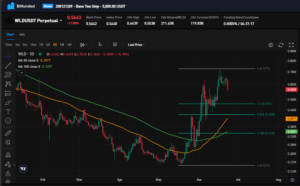
Despite the pullback, the broader trend remains constructive. Support sits near $0.47 and then $0.42. As long as those levels hold, this looks more like a healthy correction than a trend reversal.
PIPPIN is sitting directly on a major support zone. Price is holding near $0.0153 after losing short-term moving averages.
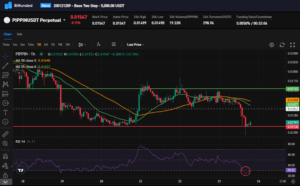
The most interesting signal comes from the RSI. RSI has fallen to roughly 31, putting the token close to oversold territory. Historically, readings near 30 often suggest selling pressure is becoming exhausted. For now, bulls need support to hold and momentum to stabilize.
ONE BULLISH STORY DURING THE BLOODBATH
Not every headline was negative. The U.S. Senate passed the 21st Century ROAD to Housing Act in an overwhelming 85-5 bipartisan vote, including a provision that would block the Federal Reserve from issuing a U.S. CBDC through 2030.
The bill now moves to the House. For much of the crypto industry, CBDCs have long been viewed as a potential competitor to decentralized digital assets. The Senate’s vote sends a clear signal that significant political resistance to a government-issued digital dollar still exists.
The market ignored the headline today but it could become one of the more important long-term regulatory developments of the year.
TRADE GLOBAL VOLATILITY WITH BITFUNDED
Markets are moving fast, and volatility continues creating opportunities for prepared traders.
👉 Access funded trading accounts
👉 Keep your personal capital protected
👉 Scale positions with confidence
👉 Take advantage of market-moving events
START TRADING WITH BITFUNDED
THE BITFUNDED TEAM