


US-IRAN WAR RESUMES: MARKETS TURN RISK-OFF
The new week is starting with the biggest geopolitical risk back in focus. After roughly a month of relative calm, the US has struck Iranian territory again, targeting two IRGC rocket launchers on Larak Island in the Strait of Hormuz. CENTCOM said the units were preparing to launch rockets carrying sea mines into the waterway, shortly after US forces had cleared mines from the main international shipping lane. Iran responded with ballistic missile attacks on US-hosted bases in Jordan, while President Trump later said that Kharg Island, Iran’s major oil export hub, was “being blown to smithereens.” The pause in the war has clearly become much less stable.
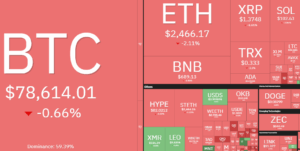
The market reaction is already telling us that traders are looking beyond the individual strike. Oil is back above $90, US equities are lower, volatility is rising and crypto is under pressure. The key issue now is whether this remains a contained military escalation or starts affecting the actual flow of energy through Hormuz. If shipping disruption returns, the consequences for inflation, interest rates and risk assets could become considerably larger than the initial headline move.
OIL WAS THE FIRST TO REACT
Brent is around $90.30 while CL is around $85.56, with both moving sharply higher as traders price a greater probability of disruption around the Strait of Hormuz. Persian Gulf and Red Sea crude exports were already running near their lowest levels since the beginning of the war, meaning the market is entering this new phase with less flexibility than it had at the start of the conflict.
The important question is not simply whether another strike happens. It is whether tankers can continue moving through the region normally. Visible tanker traffic through Hormuz remains extremely low, while some vessels are operating with AIS turned off and others are relying on escorted passages or ship-to-ship transfers. Saudi Arabia is also increasingly dependent on Gulf infrastructure, while alternative Red Sea routes remain exposed to Houthi threats.
That means insurance costs, shipping availability, escorts and actual tanker movements could become just as important as the military headlines. If those workarounds continue functioning, oil may eventually stabilize. If they fail, the current $90 Brent price could look very different.
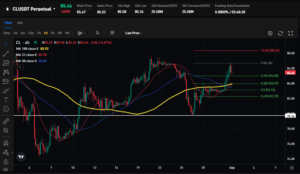
CL has reclaimed the $85 area and is now pressing toward resistance around $86.68. The recent rebound has pushed price back above the major moving averages on the 4H chart, keeping the short-term structure constructive. On the downside, $85 and $84 are the first areas to watch. A clean break above $86.68 would strengthen the upside case, particularly if it comes alongside further escalation around Hormuz.
THE FED HAS A BIGGER PROBLEM NOW
The oil shock comes at an especially difficult time for the Federal Reserve. Kevin Warsh’s Jackson Hole speech last week was already pushing markets toward a more hawkish interpretation of monetary policy. Warsh emphasized that the Fed’s 2% PCE target is firm and fixed, argued that inflation data have not shown meaningful improvement and said financial conditions do not look broadly restrictive.
He did not commit to a September rate hike, but the message was clearly not dovish. Now oil is adding another potential source of inflation pressure.
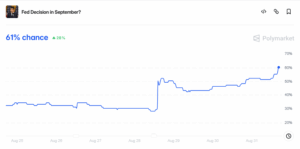
Markets are responding accordingly. September Fed hike odds have climbed to 61%, up 28 percentage points, according to the latest probability data. That means markets are increasingly pricing the possibility that the Fed may need to keep policy tighter, or even raise rates, despite the uncertainty created by the geopolitical shock.
The bond market is sending an even stronger signal. The US 10-year yield is now at 4.768%, its highest level since January 2025. It has risen roughly 87 basis points from the 3.9% area seen when the US-Iran war began. Rising oil prices are increasing inflation concerns at the same time that higher Fed hike expectations are pushing yields higher. Since mortgage rates closely track the 10-year Treasury, the move is also tightening financial conditions for households and businesses.
This is one of the most important cross-asset relationships to watch this week.
STOCKS START THE WEEK UNDER PRESSURE
The market was already dealing with a higher-for-longer Fed narrative before the latest strikes. The renewed conflict is now adding another variable that investors cannot easily dismiss. Higher oil hurts consumers and businesses, while higher yields raise the discount rate applied to growth and technology stocks.
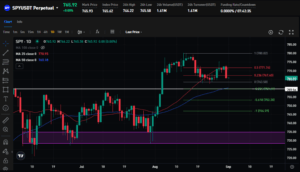
SPY is starting the week under pressure as renewed US-Iran tensions, higher oil and rising yields weigh on risk appetite. The key question is whether buyers can defend the recent breakout or whether this develops into a deeper correction.
Technically, SPY is around $767.50, with $771–$772 as the first resistance zone. $763 is the immediate support, followed by $760. A break below $760 would weaken the structure and bring $753 into focus. For now, reclaiming $771–$772 would be the first sign that buyers are regaining control.
QQQ: TECH UNDER PRESSURE
QQQ is also pulling back as higher Treasury yields pressure growth and technology stocks. With oil rising and Fed hike odds climbing, the Nasdaq remains particularly exposed to a further tightening in financial conditions.
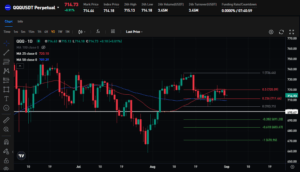
Technically, QQQ is around $675, with $680–$682 as the key resistance zone. $670 is the first support, followed by $665. Holding $670 keeps the structure relatively intact, but a break below $665 would put the recent breakout at risk. Reclaiming $680 would be the first sign of stabilization.
GOLD AND SILVER: THE SAFE-HAVEN TRADE IS NOT SO SIMPLE
Normally, a major geopolitical escalation would be expected to generate a stronger bid for precious metals. Instead, rising Treasury yields and a stronger rate outlook are creating an opposing force.
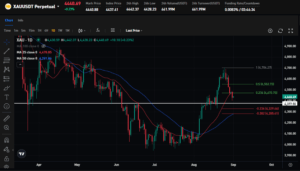
Gold has pulled back sharply from its recent highs near $4,700. $4,472 is the immediate resistance level, while $4,378 is the key support to watch. Below that, the next downside area is around $4,329. A sustained move below those levels would suggest that rising yields are overpowering the geopolitical safe-haven demand.
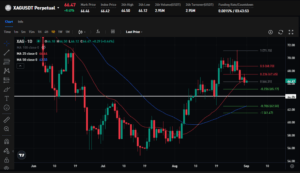
Silver has also pulled back from the $70–$71 region and is now around $66.50. The $66 area is important in the near term. The metals market is therefore giving us a useful warning: today’s risk-off environment is not automatically bullish for every traditional defensive asset.
APPLE ENTERS A NEW CHAPTER
Apple is another name to keep on the watchlist this Monday. Today is Tim Cook’s final day as CEO, with John Ternus officially taking over tomorrow, September 1. Cook will remain with Apple as executive chairman, helping maintain continuity while Ternus takes over day-to-day leadership.
Ternus has been at Apple for roughly 25 years and has led hardware engineering since 2021, giving him direct responsibility for major products including the iPhone, iPad and Mac. His appointment comes at an important moment for Apple, with investors watching the company’s AI strategy, upcoming hardware cycle and future product roadmap closely.
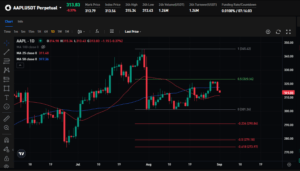
AAPL is trading around $313.83. The stock remains below the $323.34 resistance level, while the recent low around $301.26 is the major downside reference. The stock has recovered from its August weakness, but the macro environment is becoming a bigger variable. If yields continue rising and risk appetite deteriorates, Apple will not be immune.
AAPL goes on the watchlist this week both for the leadership transition and the technical setup.
STRATEGY IS BUYING BITCOIN AGAIN
Strategy is back to buying Bitcoin after roughly two months without a confirmed weekly purchase. The company disclosed that it bought 4,603 BTC for approximately $369.7 million, at an average price of $80,318 per Bitcoin, between August 24 and August 30.
That takes Strategy’s total holdings to 845,050 BTC, with an average cost of approximately $75,412 per BTC. The purchase is particularly notable because the company had spent much of the summer rebuilding its cash position and supporting its preferred-stock strategy.
Strategy funded the Bitcoin purchase primarily through its ATM program, selling roughly 4.53 million MSTR shares and raising approximately $602.8 million. The company also reported substantial dollar reserves, while Michael Saylor’s message accompanying the move was simple: “We’re ₿ack.”
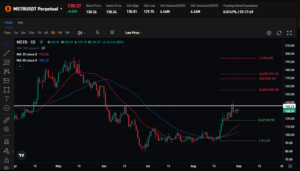
The MSTR chart is still highly sensitive to the macro environment. The stock is around $130, with $135.73 acting as the immediate resistance level. A sustained break above that area could open the door toward $155, while failure to reclaim resistance would leave MSTR vulnerable if Bitcoin and broader risk assets continue to weaken.
HOOD IS ANOTHER STOCK TO WATCH
Robinhood Chain recently reached roughly $2.66 million in 24-hour app revenue, briefly moving ahead of Hyperliquid and Ethereum in the cited figures. That gives HOOD another fundamental catalyst as the company continues expanding deeper into crypto infrastructure.
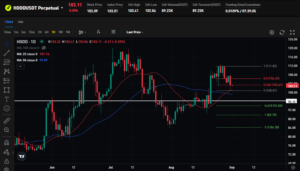
The technical picture is more cautious. HOOD is trading around $103, with resistance around $106–$111 and support near $100.80, followed by the $96 area. The stock can continue outperforming if risk appetite stabilizes, but its high-beta characteristics mean it could also react sharply if the broader risk-off move accelerates.
CRYPTO STARTS THE WEEK COOLING OFF
Bitcoin is trading around $78.6K, Ethereum around $2,470, and the broader market is predominantly red. The Crypto Fear & Greed Index has fallen to 62 from 69 yesterday and 73 last week, showing that sentiment is cooling even though the market remains in greed territory.
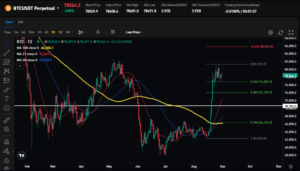
BTC has been rejected around the $80K region and is now below the short-term resistance cluster around $79.3K–$80.1K. If $76.9K breaks decisively, the next major support sits around $74.1K, with the $70.5K area becoming relevant if risk-off conditions intensify.
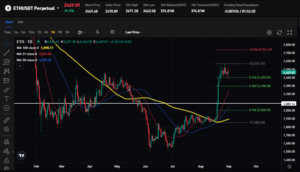
ETH is around $2,470, with $2,403 as the first major support and approximately $2,298 below that. A recovery above $2,500–$2,520 would improve the short-term structure, but the macro environment remains the bigger driver.
The important shift is that crypto is no longer trading independently of traditional markets.
SOL IS STILL SHOWING RELATIVE STRENGTH
Solana remains one of the more interesting charts in the crypto market. SOL is trading around $102.70 after its recent breakout and is still showing relative strength compared with several major assets.
There is also a fundamental catalyst behind the move. Recent governance developments around Solana’s supply and deflation proposals have added another layer to the SOL story, giving traders something to watch beyond price alone.
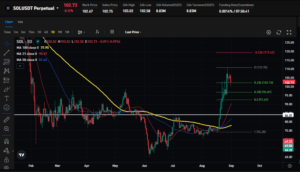
Technically, $102 is the immediate support area, followed by $96.8 and $92.5. SOL remains constructive as long as those levels hold, but the real test comes if the broader market enters a deeper risk-off phase.
That is what makes SOL particularly interesting this week. Can it continue outperforming while BTC, equities and other risk assets are under pressure?
HYPE remains one of the stronger names in crypto, and a potential U.S. market entry through talks with Kraken’s parent company adds another catalyst to the story. The key question is whether that relative strength can hold if the broader market continues moving risk-off.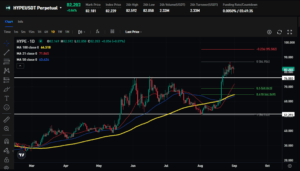
Technically, it is around $82, with $87 as the key resistance. $76 is the major support; holding above it keeps the broader bullish structure intact. A break below $76 would suggest the wider risk-off move is starting to catch up.
KEY EVENTS TO WATCH THIS WEEK
Each print can shift rate expectations.
MON: Chicago PMI
TUE: ISM Manufacturing + JOLTS
WED: ADP Jobs
THU: ISM Services
FRI: NFP + Unemployment
STAY AHEAD OF THE VOLATILITY
Geopolitical risk is back and markets are entering the week with higher yields and rising Fed hike expectations. The key now is to respect the levels, watch liquidity and avoid chasing.
Trade stocks, crypto, commodities and indices 24/7 without risking your own capital with Bitfunded.
THE BITFUNDED TEAM